Could not resist a Craigslist posting last week for a 1989 Guild D-15M, of Westerly RI-vintage, with several upgrades for short money. The D-15 "Mahogany Rush" is a dreadnought-sized guitar made from 1983 to 1994 that is listed on the old Westerly Guild Guitars site (and in the Blue Book) as having a Mahogany top, back, and sides. This 1989 D-15M, though, appears to have a Mahogany-stained Spruce top and has an arched laminated back, both features also available in later D-25 models that also originally came in solid Mahogany. The sides appear to be maple as opposed to the darker Mahogany on my 1981 D-25M. Unfortunately, Guild is notorious for having incomplete production records, so it is not surprising to have a Guild guitar that is not officially recognized anywhere!
Turns out this was a lefty model that was later converted to a righty with a new bridge and compensated bone saddle, bone nut, and second pick guard a la Richie Havens' Guild Signature Model. The original tuners had also been replaced with Sperzel locking tuners. Condition-wise, this D-15 was in good shape besides a few small dings. The action was good and the sound clean. The seller, a professional musician, was winnowing the herd. With a few other interested parties in the wings, I was only able to negotiate a small reduction in the asking price, but it was too good a deal on a classic Guild to pass up.
Friday, March 13, 2015
Sunday, November 23, 2014
Another 30-Year Closet Find (1981 Yamaha FG-750S)
The Yamaha FG-750S made from 1979 to 1981 should not be confused with the later model going by the same designation. Both have a solid Sitka Spruce top (designated by the "S" suffix), but the older model has a Mahogany body while the newer model is Sycamore. The 1981 FG-750S also still has the tension rod adjustment in the head of the guitar instead of the body. Note the cool wood truss rod cover that is characteristic of the late 70s Yamaha guitars versus the later headstock featuring Yamaha's leaf logo. These mid-level guitars (top of the line Yamaha production models of this era were designated as the L series beginning in 1978) are valued for their solid craftsmanship, durability, and playability. I find the tone on these older Yamahas to be much richer and less tinny than the more recent models. If you are lucky enough to find one in good shape, these guitars will give you years of enjoyment without having to break the bank.
Turns out this was another great closet find! The guitar had been the current owner's dad's and the seller had never learned to play it. As a result, the guitar was in great shape overall, with tell-tale ancient strings that clearly had not been changed in decades. The fretboard was dirty but not indented, the frets showed only minimum wear, and all of the original saddle height was intact for any needed adjustments. The top was the golden honey tone one would expect from over three decades of mellowing. Only the nut showed damage, having been chipped, but it was an easy replacement for my luthier to make. It's always gratifying to bring a classic Yamaha acoustic back to life.
As an unexpected bonus, the guitar came with a newer TKL hardshell case, worth at least a third of what I ended up paying for the guitar, and which I promptly adopted for my recent 1970 Martin D28 acquisition whose case I had had to trash due to mildew. Outstanding.
Saturday, November 15, 2014
Guitar Shrubbery
In case you have a large plot of land in need of some shrubbery, here's some inspiration for your own guitar-inspired design!
7,000 Cypress and Eucalyptus trees make up this guitar design on a farm in Argentina. Read the whole story here.
Saturday, April 26, 2014
1998 Martin HD-28
I traveled a little out of my way for this 1998 Martin HD-28, enticed by its alleged great condition and a drop in asking price below Blue Book value. I pounced immediately and was not disappointed. This is another Craigslist beauty!
The Martin HD-28 is an updated version of the 1930s/1940s version of the Martin D-28 that features the herringbone purfling (hence the "H"), scalloped bracing, and the tortoise-colored pickguard of that era. Introduced in 1976, the Martin HD-28 is a dreadnought-style guitar with a solid Spruce top and Indian Rosewood body, and has featured Martin's new low-profile neck since 1987. The current Martin HD-28 model lists for $3,649, with a street value of $2,700 and a Blue Book value up to $1,850 second-hand. Models from the 1990s, 80s, and 70s, are progressively more valuable with age.
This 1998 Martin HD-28 was kept as a "house" guitar by a fellow guitar aficionado who had other guitars for use out on his occasional gigs. The guitar was ding-free and showed no signs of play wear on the neck or body. Even better, the Spruce top had started darkening to a beautiful golden hue. The set up looked to be perfect with a bone compensated saddle upgrade so I was initially puzzled to hear a mysterious buzzing as I played the guitar. When I tapped the lower bout behind the bridge, however, the tell-tale vibrations of a loose brace under the top of the guitar were unmistakeable. Without a luthier's mirror to investigate the full extent of the needed repair, I negotiated an additional discount from the asking price, and made off with my prize. My luthier will have to tell me whether the brace simply needs re-gluing or is broken and needs to be replaced. Regardless, this is a beautiful guitar that deserves to be restored to its full glory.
The Martin HD-28 is an updated version of the 1930s/1940s version of the Martin D-28 that features the herringbone purfling (hence the "H"), scalloped bracing, and the tortoise-colored pickguard of that era. Introduced in 1976, the Martin HD-28 is a dreadnought-style guitar with a solid Spruce top and Indian Rosewood body, and has featured Martin's new low-profile neck since 1987. The current Martin HD-28 model lists for $3,649, with a street value of $2,700 and a Blue Book value up to $1,850 second-hand. Models from the 1990s, 80s, and 70s, are progressively more valuable with age.
This 1998 Martin HD-28 was kept as a "house" guitar by a fellow guitar aficionado who had other guitars for use out on his occasional gigs. The guitar was ding-free and showed no signs of play wear on the neck or body. Even better, the Spruce top had started darkening to a beautiful golden hue. The set up looked to be perfect with a bone compensated saddle upgrade so I was initially puzzled to hear a mysterious buzzing as I played the guitar. When I tapped the lower bout behind the bridge, however, the tell-tale vibrations of a loose brace under the top of the guitar were unmistakeable. Without a luthier's mirror to investigate the full extent of the needed repair, I negotiated an additional discount from the asking price, and made off with my prize. My luthier will have to tell me whether the brace simply needs re-gluing or is broken and needs to be replaced. Regardless, this is a beautiful guitar that deserves to be restored to its full glory.
Sunday, January 19, 2014
Martin Guitars Exhibit at the Met!
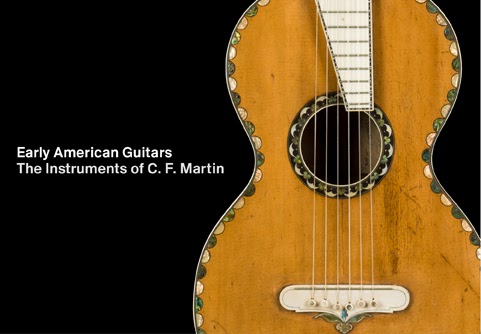
Happy New Year fellow pickers! If you will be in New York City in 2014, do not miss the Metropolitan Museum of Art's special exhibit sponsored by The Martin Guitar Company featuring Martin guitars gathered from private collections, the Martin Museum in Nazareth, PA, and the Met's own collection. This early American guitars exhibit just opened and will be up through December 7th, 2014.
Among the 35 historic Martin instruments on display are the earliest known guitar signed by C.F. Martin who came to America in 1833, the first known Martin model featuring the now preferred x-bracing construction supporting the guitar top, and Eric Clapton's 1939 Martin 000-42 featured in his Unplugged MTV concert in 1992. This last guitar sold at auction in 2004 for $791,500 to benefit Eric Clapton's Crossroads rehabilitation centre in Antigua, setting a world auction record for a Martin guitar!
Please drop a comment if you get to see these one-of-a-kind guitars before I do. Here's a preview and another!
Among the 35 historic Martin instruments on display are the earliest known guitar signed by C.F. Martin who came to America in 1833, the first known Martin model featuring the now preferred x-bracing construction supporting the guitar top, and Eric Clapton's 1939 Martin 000-42 featured in his Unplugged MTV concert in 1992. This last guitar sold at auction in 2004 for $791,500 to benefit Eric Clapton's Crossroads rehabilitation centre in Antigua, setting a world auction record for a Martin guitar!
Please drop a comment if you get to see these one-of-a-kind guitars before I do. Here's a preview and another!
Saturday, October 12, 2013
2011 Martin D-18P
In another eBay bargain purchase, I decided to give the 2011 Martin D-18P a try. This is the classic D-18 with a solid Sitka Spruce top and Mahogany body, but Martin put its slimmer performance artist profile neck on this guitar and called the model the D-18P. Apparently, the high performance neck was popular because Martin went ahead and made it standard on the 2012 D-18, along with some other changes, making the D-18P designation obsolete after only one year. (Note that one should not confuse this model with the 1987-1989 D-18P, which was the designation made by Martin for D-18 model guitars that they continued to make with the old neck style after a change to a lower profile neck on the standard D-18 in 1987). Street value new for the 2011 Martin D-18P is $2,000, while current Blue Book value in excellent condition is between $1,175 and $1,375.
When I received this brand new guitar I was initially disappointed as it played all buzzy and was in serious need of a proper set-up. Now that I have gotten it back from my guitar tech, though, I can't stop playing it. What a difference! This is a responsive guitar that is wonderfully playable all the way up and down the frets. It sports a 1.75 inch nut (compared to the earlier D-18 nut at 1.6875 in.), a compensated saddle, and a low profile high performance neck, which makes it easier on the hands and ideal for finger picking. The tone is super clear and bright. I applaud Martin's move to the faster neck on its iconic D-18 model, which makes this dreadnaught an even better workhorse for the serious player. If you haven't played any of these new Martin D-18's, I think you'll be impressed when you finally do.
Thursday, October 3, 2013
O-oh, That Musty Feeling (1970 Martin D-28)
Serendipity struck again last month as I scored a beautiful 1970 Martin D-28 guitar off of Craigslist. Turns out the seller is the same guy who had previously sold me a wonderful Martin 000-1. He is slowly whittling down his collection as he no longer plays much due to some chronic tendonitis. I peppered him with questions over the phone and confirmed that the guitar was in excellent condition so I headed over to see it within hours of its listing. The D-28 is the flagship Martin dreadnought guitar. It features a solid Sitka Spruce top and solid East Indian Rosewood back and sides. The 1970 D-28 model was the first to be made with East Indian Rosewood after Brazil put an embargo on Brazilian Rosewood logs, making it impossible for Martin to obtain sufficient quantities. It has a Blue Book value between $1875 and $2350 in excellent condition. By comparison, a 1969 D-28 made with Brazilian Rosewood is valued between $4500 and $6500 in excellent condition!
Before even picking this D-28 up, I was struck by its darkly burnished golden hue that only comes with decades of aging. The plastic binding around the body had likewise yellowed, but was still tight to the body with no cracks. The guitar itself had no cracks and only a few minor dings and faint checking in the finish. The frets and fretboard were in surprisingly good shape given that the guitar was definitely played. The seller explained that he had had the guitar recently serviced by a well-respected local luthier who had re-glued the slightly shrunken pickguard. That the guitar was also perfectly set up at that time was immediately obvious upon playing the instrument. This is a booming guitar that played comfortably up and down the neck with no intonation issues. At this point I knew I might not ever get another chance to own such a beautiful instrument at the asking price so I gladly paid up and left with my prize.
By the time I got home, though, it was obvious that I had a mold issue as the guitar case was stinking up the car. When I took the guitar out, it too was impregnated with a powerful musty smell. Bummer!The first thing I did was clean the exterior of the guitar with a guitar cleaner and soft guitar cleaning cloth. As the guitar still reeked, I dropped some rice in the body and left the instrument to lay flat out of the case for 24 hours. That, and sitting out of the case for a few weeks, has definitely helped.
The guitar case I set open outside in the sun for a week with little effect. Products like Febreeze simply mask the smell, but don't attack the cause. If baking soda and a white vinegar spray don't work next, sadly I may just have to trash the case (despite it having a certain mojo, including several bluegrass festival stickers). If you have successfully banished that musty smell from a guitar case, let me know what was your secret formula in the comments below.
Subscribe to:
Posts (Atom)