Saturday, November 24, 2012

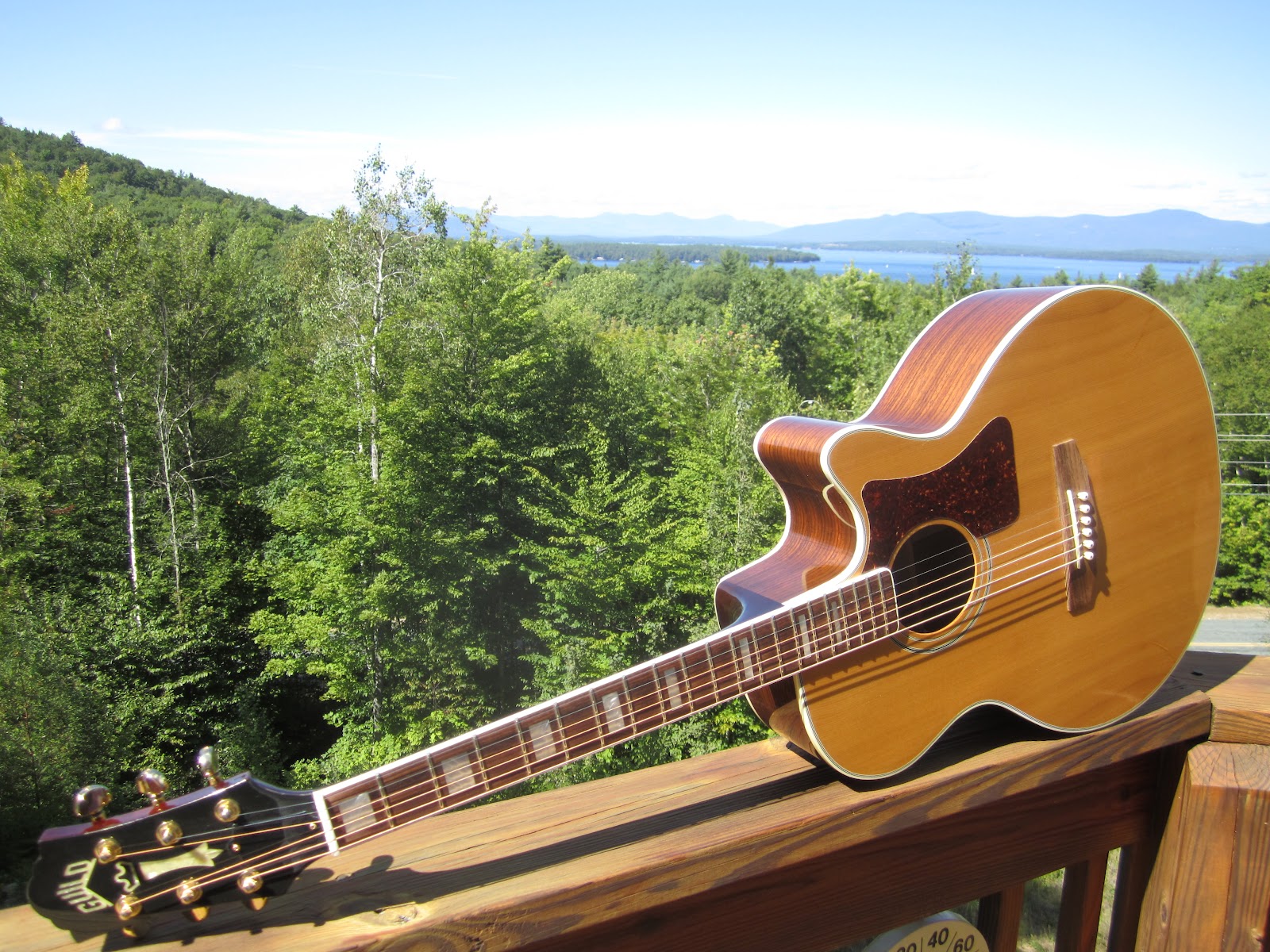
Thanksgiving (Guild CV-2C)

Spending the Thanksgiving weekend up in NH with family and feeling very thankful.  Everyone is healthy, we have a roof over our heads, with electricity and heat, and we are employed.  These are all things we have recently been reminded not to take for granted between the still lingering effects of the 2008 recession and Hurricane Sandy's devastation along the East Coast.

I've been working two jobs lately and have not had much time to pursue any neglected guitars or find good homes for the ones I already have in the stable.  The Thanksgiving break is thus a welcome chance to spend some time playing, tweak the action on one guitar, and finally get around to customizing one of the guitars I plan to keep - my Guild CV-2C.  First, I upgraded the original bridge pins inserting bone bridge pins with abalone insets.  Next, I swapped out the original black plastic truss rod cover with a hand-crafted ebony wood cover inset with Mother of Pearl and Paua Shell in the form of a fleur de lis in honor of my French heritage.


I highly recommend the craftsman in Winnipeg Canada who sells these handmade truss rod covers on eBay for any different number of guitars, including Guild, Gibson, and Taylor.

Of my growing collection of guitars, it's the Guild CV-2C I brought over to our friends' house for Thanksgiving dinner after which we enjoyed a musical evening.  Happy Thanksgiving to all!

Sunday, October 7, 2012

Guild Guitars is Back!

It is no secret that American guitar-maker Guild, founded in 1953, has gone through numerous changes in recent years.  After the guitar company was purchased by Fender in 1995, there was the Guild departure from its long-time manufacturing site in Westerly, RI, for the west coast in 2001. Soon thereafter the Guild facility was moved from Corona, CA, to Tacoma, WA.  In 2008, Guild moved back to New England after Fender bought Kaman Music Corporation's production facility in Connecticut.  Each change brought some discontinuity and uncertainty that negatively affected customer and dealer enthusiasm and loyalty.  Product lines came and went, some of the records on older models were lost along the way, and confidence in contemporary Guilds as a marquis guitar brand waned.  Resale values on Guild guitars cannot compete, for example, with those for guitars from C.F. Martin & Co., a family-owned company that has been making guitars in the same location in Nazareth, PA, continuously since 1838.


Well, this past week I was lucky enough to be given a complete tour of the workshop floors of the new Guild manufacturing facility in New Hartford, CT, hosted by Guild with a group of fellow Guild aficionados who congregate online at Let's Talk Guild.  It is a bright and clean facility occupying a historic pre-civil war manufacturing plant that years ago housed a cotton mill and a sewing machine manufacturer, among others. It is retro-fitted with sophisticated temperature, humidity, and dust controls to maintain an ideal guitar-making environment.  It was fascinating to watch programmed routing machines cut out various guitar parts with lazer-like accuracy while individual shop workers sculpted guitar necks, assembled guitar bodies, and applied sunburst finishes by hand.  Huge computer-controlled lathes operate next to industrial-era hand presses.  We were able to view every aspect of guitar building from the wood supply room to the final set up of a finished instrument.

What was striking was the obvious enthusiasm and pride every employee had, from shop-floor artisans to top management, for the production of beautifully crafted instruments.  Most employees there have been making guitars for years, if not decades.  They share responsibilities for multiple stages of the guitar-building process and each is empowered to reject work that does not meet the shop's high quality standards.  Master Luthier Ren Ferguson, overseeing acoustic engineering for Fender as of this year after decades at Gibson, summed it up best for us: "Why build a guitar out of something that doesn't already have music in it?"  That Fender was able to lure Ren away from settling into a tranquil retirement in the Midwest to instead participate in research and development at Guild speaks volumes about a renewed commitment to produce the highest quality Guilds yet.

Picture courtesy of Brad4d8
Another score for Fender this year is signing up Doyle Dykes to represent Guild guitars.  Doyle is a premiere fingerpicking guitarist who helped put Taylor guitars on the map, but some of his earliest guitars were Guilds. Doyle was in New Hartford, CT, this week to finalize Guild's first signature model, a custom F47-sized acoustic/electric with quilted Maple back and sides. We had the chance to play the prototype, still being tweaked to Doyle's specifications, which will be launched in January 2013 at the annual NAMM (National Association of Music Merchants) trade show in Anaheim, CA.  It is a beautiful guitar and Doyle made it sing in a private concert for our group after lunch.  I was especially touched with Doyle's tribute to the 9/11 victims, an instrumental piece whose hook references two-tone rescue sirens and reminded me of the plaintive fire-fighter rescue beacons that littered the World Trade Center site after the towers came down.  I was not the only grown man in the audience who shed some tears.

Picture courtesy of Alive@RandyWalters.com
Guild will also be celebrating its sixtieth anniversary next year, and is preparing a limited run of anniversary guitars to be also unveiled at the NAMM show.  We were able to view a number of these special all-koa-bodied guitars, which will be limited to 60, at various stages of production.  I was also able to spend some time later in the day playing one of the finished guitars.  Sweet!

The take-away is that Guild is back up to speed making its Standard and Traditional Series lines of guitars in quantities that should meet demand, along with some exciting custom projects, while maintaining its tradition of hand-crafted instruments.  Guild is back baby!

P.S.  We were under strict orders to leave our cameras at the door, but here is an article with great shop-floor pictures of the Guild guitar-making process at the New Hartford, CT facility.  Additional pictures are posted on Guild's Facebook page.

Saturday, September 29, 2012

eBay Reality Check (1983 Guild F-45CE)

eBay uses a grading system to enforce transparent transactions and weed out sketchy players. Sellers and buyers have their number of transactions tracked and their feedback is available for viewing. The higher the number of transactions with positive feedback the more confidence one can have. Parties thus have an incentive to promptly resolve any concerns that do come up in order to maintain positive feedback on all their transactions.  In extreme circumstances, eBay itself can and does intervene to level the playing field when a party is trying to unfairly game the system.

That said, there are some tips to keep in mind when buying and selling guitars on eBay. There is no better predictor for a smooth transaction than previous experience at buying or selling guitars online.  Check whether the buyer or seller has consistently positive feedback specifically on guitars or other similar musical instruments (unfortunately, eBay only lists the item bought or sold for transactions within the last 90 days).  Check for the seller's return policy.  In the event you need to return an item you will usually be responsible for return shipping and may even be assessed a re-stocking fee.  Don't forget to factor in shipping costs when bidding on a guitar.


Should you be the lucky winning bidder on a beautiful guitar at an attractive price that then arrives and is not as advertised, eBay provides a platform to try to resolve the issue directly with the seller.  Short of returning the guitar, which some sellers do not provide for, one can request a partial refund based on material omissions or misrepresentations in the description of the item.  If you have a legitimate complaint, most sellers will negotiate a partial refund that is acceptable to both parties in order to avoid negative feedback.  It is important to hold off on your feedback until the transaction is entirely complete to your satisfaction, as that is your only real leverage short of elevating the dispute to eBay management.

Last week I received a 1983 Guild F-45CE purchased on eBay.  I know this model well having successfully bought, restored, and sold a 1984 version earlier this year.  There were few bidders so I could not resist bidding even though the seller had very little history on eBay and none for musical instruments, and accepted no returns.  There was only one picture (sellers have to kick in a little extra to add multiple pictures to listings) and the description was unenlightening as to the guitar's condition.  The seller had answered some relevant buyer questions that were posted, however, including an assurance that the guitar had "no dents or scratches" and no issues, and that the guitar case was beat up, but functional.  My winning bid was well below Blue Book value.

When the guitar arrived, the packaging itself did not inspire confidence.  The seller had taken some recycled cardboard sheets and taped them together over the guitar case.  Not only was there no extra padding provided, but the tape at the bout of the guitar case had split open so that the base of the guitar case was completely unprotected from the vicissitudes of shipping. Note that if you have a guitar to ship, all you have to do is go to your local guitar/music store and pick up a discarded guitar shipping box by either asking or going around back and dumpster diving.  Bubble wrap, packing paper, or the like, should be used both inside the guitar case and around the case to stabilize the guitar.  Extra care should be taken if the guitar is being shipped without a case.  It is also best to loosen the string tension befor shipping.

The guitar itself arrived intact, thanks to the US Postal Service and a hardy case.  On inspecting it though, I found several obvious dents and scratches on the guitar despite the seller's assurances to the contrary.  Even more significant, the bridge was visibly lifting off the body and showed evidence of an unsuccessful re-glue.  Vintage instruments lose value when they are cosmetically damaged, and even more value when they have to be restored.  This was no longer a good deal.

I contacted the seller with pictures and after several days of exchanging emails we settled on a partial refund that should cover the cost of having the bridge professionally removed and re-affixed, and account for the cosmetic issues.  Once agreed upon, a refund is easily processed through Paypal without having to disclose any financial information, as eBay has made linking to Paypal accounts part of its platform.  I should still be able to find a good home for this cool vintage guitar and come out ahead.  Live and learn.

Sunday, September 23, 2012

2007/08 Guild CV-2C Antique Burst

Guild's 2006-2008 Contemporary Series guitars were the guitar maker's brief foray into bolt-on necks.  One of the desired advantages was that a neck reset (adjustment of the neck angle required when smaller truss-rod or saddle and nut adjustments can no longer produce the desired string height and intonation over the fretboard) would no longer require ungluing the bonded wood dovetail neck joint at the body of the guitar. Unfortunately, a number of these guitars were reportedly sent back to Guild with various neck, fretboard, and joint problems.  When Fender moved Guild acoustic guitar production in early 2008 from Tacoma, WA, back to the East Coast, Fender presumably decided that transferring the Guild Contemporary neck-block technology to the Kaman Music manufacturing facility in New Hartford, CT (yet another Fender purchase) was not worth the effort and Guild discontinued the series. Defective and new unsold models were all processed alike through a commercial refurbisher and are still fairly common on the re-sale market, but with the word "USED" imprinted on the back of the headstock and the serial number on the label blacked out to void out the Guild warranty.  Because of the poor history of these models, their resale value is not strong whether new or second-hand, and you can pick up one of the "refurbished" guitars new at half to less than a third of what they originally sold for.  The trick is not to pick up a lemon.

The top of the Contemporary Series line was the CV-2C, a F-40 Orchestra-style body guitar with Florentine-style cutaway, solid Red Spruce top, solid flame Maple back and sides, one-piece Mahogany neck, multi-layer ivoroid binding, Ebony fretboard and bridge, a Madagascar Rosewood and ivoroid, red, and black inlaid accent lines rosette, Chrome Gotoh tuners, and D-TAR Wavelength Load and Lock pickup and electronics.  It was manufactured for less than a year with a MSRP of $3,000 and a street price (true retail) of around $2,250. I have been tracking these guitars on eBay for several months now, attracted by the chance to buy a lot of guitar for much less than the current retail price for similar new models such as the Guild F-40 Traditional Series acoustic (approx. $2,650 street price in Antique Burst) or the F-47MC acoustic/electric (approx. $3,050 street price in Antique Burst).

So it was with great anticipation that I received my latest eBay purchase this week, a 2007/08 CV-2C in Antique Burst (no way to determine which year as it is a "refurbished" model with a blacked-out serial number). It came in a brand new Guild deluxe TKL hardshell case. The guitar itself was new, as advertised, without any visible blemishes.  The Antique Burst finish is beautiful, especially after a good cleaning.  The inlaid Madagascar Rosewood rosette is especially striking.  Once tuned up, I was relieved to find no issues with the neck, the set-up, or the intonation.  The fretboard is tightly flush to the body of the guitar (one of the potential issues with these models based on anecdotal on-line evidence).  Unless you look inside the body of the guitar, the ill-fated neck block system is undetectable.  What is immediately noticeable is the wonderful warm tone of this solid Maple-bodied guitar, my first ever.  The Wife was immediately seduced by it, instructing me not to resell this one!

Curious to confirm our initial impressions, we conducted an unscientific test.  I pulled out my 2001 Guild F-47RCE (solid Rosewood back and sides), which played brighter, but less warmly.  Then I switched to my 2011 Guild GAD-25 (solid Mahogany back and sides), which sounded much darker. These are guitars I really enjoy, both aesthetically and sonically, but I am definitely a new convert to Maple and plan to keep my eye out for other interesting Maple-bodied guitars.  In the meantime, the CV-2C is a welcome addition to the stable.  Anyone else a fan of Maple...?

Wednesday, September 5, 2012

eBay Find (1999 Guild F-47RCE)

First, let me say that nothing beats walking into a well-stocked premium guitar store where the staff have been playing, maintaining, and selling guitars for years. Whether you are a beginner or an experienced guitar aficionado, such visits should be savored not for the prospect of buying a guitar, but for the pleasure of experimenting with the visual, tactile, and auditory cornucopia of multiple instruments one after another. Comparison playing is experiential learning at its best and the differences are often not so subtle as to be beyond even a beginner's appreciation. How you rank those differences however, is subjective, so that there is no definitive list to consult as to the best guitar at any given price point. Such a visit should thus be part of every curious guitar player's repertoire whether you are in the market for a guitar or not.

Once you have identified the size, type, and perhaps brand models that you most enjoy, and gotten over the sticker shock, you can buy a new guitar from the store with which you are by now familiar. This is probably the best bet for the beginner or intermediate player with little guitar-purchasing experience. In the unlikely event you purchase a lemon, you can enlist the store's help in activating your warranty remedies (a repair or replacement).

For the more experienced guitar purchaser there are other less expensive options online. Local listings on Craigslist allow you to test drive the principally second-hand instruments and negotiate a good price directly with the seller based on your assessment. This holds true even more with premium models, where you want to make sure the guitar has the sonic and playing personality you desire before dropping several thousand dollars. The downside to a local Craigslist search or even a guitar store is that certain brands and models are rarely listed or on display. Even a well-established brand like Guild, for example, has little representation of its current model line in the Boston area and only occasional local second-hand listings.

The obvious alternative is an eBay search, opening up a huge national market for both new and second-hand instruments. If no private or commercial seller has the particular guitar you are looking for at the time, you can have daily search results sent to your email so you don't miss a listing.

This is how I was alerted to only the second Guild F-47RCE to be listed on eBay this year. This is a Westerly, RI-made model that was discontinued sometime after Guild moved production to the West Coast in 2002. I know the guitar well because I purchased a 2001 model earlier this year off of Craigslist locally. It has a cutaway grand concert-style body, solid Spruce top, Rosewood back and sides, scalloped bracing, Mahogany neck with bound Rosewood fingerboard and pearloid block inlays, and logo and Chesterfield pearl inlays on the headstock with Gold Grover tuners. After a professional set-up and some cosmetic repair work, it is one of the nicest instruments I own.

The particular listing title for this 1999 model was incomplete ("Guild F-47CE"), so I was pleased but not surprised to be the winning bidder at $400+ under the Blue Book value for this top-of-the-line (at the time) F-47 model. I was even happier upon delivery of a nearly flawless guitar as described. The original Guild hardshell guitar case is in like-new condition. The guitar itself has no dings and only some minor pick wear on the sound-hole above the pick guard to suggest that it has been well-played over the last dozen years by its single owner. There is one small area of binding separation from the body, which seems to be a recurring issue with these Westerly-made Guilds, but an easy fix. The frets were professionally replaced and are like-new, and the nut was upgraded to bone.

The disadvantage of eBay is that you are purchasing a musical instrument without being able to play it before delivery. Some sellers are happy to give you an in-hand description over the phone, but this is only as good as the seller's ability to give you an accurate read on the instrument. Some also post video samples of the instrument being played, which can be helpful. I only had a brief written description and some pictures to go on. This is why I held my breath as I took the Guild out of its case for the first time, tuned it up, and played it... Joy and relief! It has a balanced warm tone that is well-defined across all registers whether amplified or unplugged. The sustain is wonderfully rich and strong. The action may be a tad high, but that is easily adjusted. A week later and having enjoyed it over the Labor Day weekend, I am still reveling in my good fortune.

Saturday, August 11, 2012

Summer Livin' (1979 Yamaha FG-335)


Threw my travel guitar in the car for a summer weekend on Moose Pond in Maine where my friends are hosting.  My 1979 Yamaha FG-335 is always ready to go.  It is a solid guitar with great volume and intonation.  After thirty years in a closet, it just needed a little TLC to bring it back to life. Now it has also flown over the Atlantic in carry-on and because it does not need to be babied, I end up playing this guitar more than my Martins and Guilds.  It has turned out to be one of my best Craigslist buys.  Carpe Diem!

Tuesday, July 31, 2012

Irish Seisiun (1964 Martin D-28)

Monday nights are Irish Seisiun nights at the Green Briar Irish Pub in the Brighton neighborhood of Boston just around the corner from St. Elizabeth's Hospital.  Starting at 7pm, musicians of all levels are welcome to come learn and play along to the standards, while at 9pm, the regular seisiun begins with the veteran players.  This week, I took my son who plays violin to introduce him to some good fiddle music.

Propped up in the veteran musician's corner before the regular seisiun began I spied what looked like a vintage Martin guitar.  From afar, though, the logo was too faded to read and the guitar was sporting an uncharacteristic Gibson-like pickguard. Intrigued, I asked around until I met the owner, Terry, a good Irish lad.  He confirmed that it was in fact a 1964 Martin D-28, but that he had replaced the original pickguard after it developed a crack. He also noted that he would be mostly playing banjo that evening as without amplification guitarists tend to break a lot of strings trying to be heard over the accordeons, banjos, and fiddles.  Indeed, he recently had a Fishman pickup installed in the Martin for when he plays out in more formal settings.  With a pint of Guinness and friends old and new, you could do worse than to spend a musical evening with lads like these.  Cheers.